
Why Input Controls Can Make or Break Your Game

Lessons from building the input control system for Gangs of Gaddis
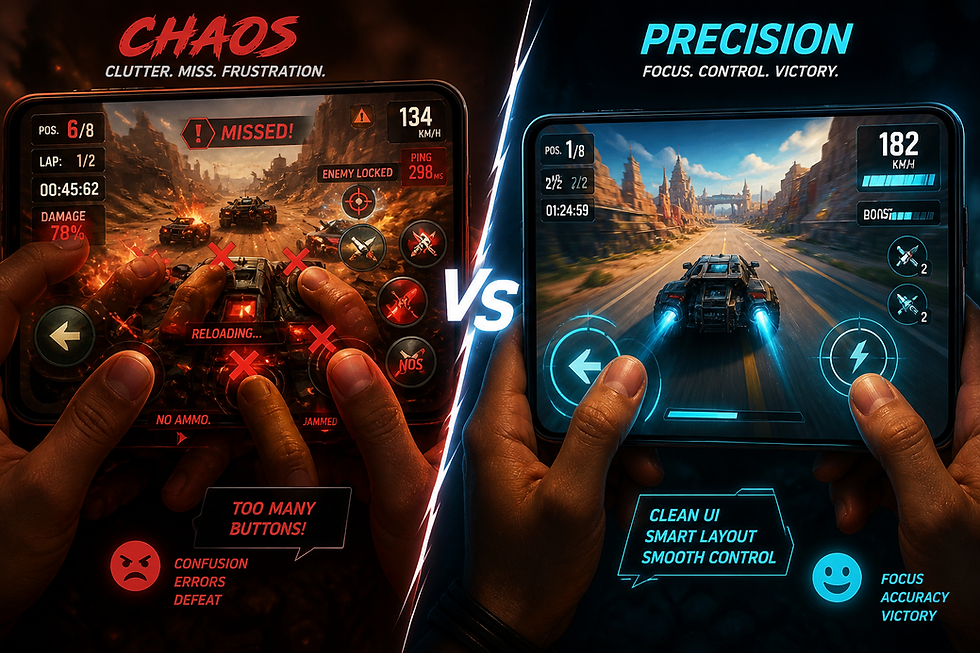
When we talk about great games, we often focus on visuals, mechanics, or progression systems. But there’s a layer underneath all of that which players interact with every single second, The input system. If that layer feels off, everything else starts to crumble.
While building Gangs of Gaddis, input controls became one of the most critical pillars of the experience, especially because the game is designed for mobile vehicular combat. Precision, comfort, and responsiveness aren’t just nice-to-haves, they define whether the game feels playable or frustrating!
Old Controller Layouts
Familiarity First, Innovation Second
One of the earliest decisions I made was simple: don’t fight player muscle memory.
Mobile vehicle games have already established certain control patterns that players are comfortable with. Instead of reinventing everything, I focused on supporting multiple familiar control layouts so players can choose what feels natural to them.
Currently, the game supports four different control schemes, each catering to different play styles. This flexibility ensures that both casual players and competitive players can find a setup that works for them.
Introducing the Powerup Joystick
Where things get interesting is the Powerup Joystick.
Vehicular combat isn’t just about driving. It’s about aiming, timing, and reacting. Traditional buttons weren’t expressive enough for this, so I introduced a dedicated joystick to:
Select powerups intuitively
Aim in any direction
Fire with precision
Cancel actions via dead zones
This adds a layer of control that feels closer to a twin-stick shooter, while still being optimized for mobile touch input.
Real Testing with Real Players
No input system is complete without feedback.
I tested the controls with:
People I know personally
Targeted player groups
The goal wasn’t just to see if it “works,” but whether it feels natural. The responses have been encouraging, especially around comfort and ease of understanding.
That said, input systems are never truly finished. They evolve with player feedback.
Solving Touch Conflicts (The Core Problem)
One of the biggest problems in mobile input systems is input ambiguity when one finger accidentally triggers multiple UI elements.
To solve this, I designed a system where:
Each finger owns exactly one interaction from the moment it touches the screen.
In practice:
A touch assigned to acceleration won’t trigger braking
Steering input won’t interfere with camera control
Dragging across UI won’t accidentally activate other buttons
This is implemented directly at the input handling level in C++, ensuring deterministic behavior and zero ambiguity.
You can see a similar pattern in how touch indices are tracked and isolated per control in the controller layer. Where each interaction (steering, throttle, brake, camera) is bound to its own touch lifecycle.
Building It from Scratch (and Why It Matters)
For Gangs of Gaddis, I built the entire input system from scratch in C++.
This gave me full control over:
Touch handling
Input routing
Performance optimization
One key design decision was finger ownership:
Each finger is bound to a single UI control from the moment it touches down.
What this means in practice:
If a player presses a button, that finger won’t accidentally trigger other buttons
Dragging across UI elements won’t cause unintended inputs
Every interaction remains consistent and predictable
This eliminates a huge class of common mobile input issues, especially in intense gameplay scenarios.
Final Controller Layouts
Final Thoughts
Input systems are often invisible when done right and painfully obvious when done wrong.
For Gangs of Gaddis, the challenge wasn’t just building controls , it was designing a system where:
Complexity feels simple.
With multiple layouts, a dedicated powerup joystick, and a carefully engineered touch system, the foundation is in place. But this is still an evolving system shaped continuously by player feedback.
Would love to hear your thoughts: How do you prefer your controls in mobile combat games simple layouts, or more expressive systems like dual joystick inputs?
And if you’ve seen the gameplay video , what do you think that mysterious circle control is really doing? 👀


Comments